
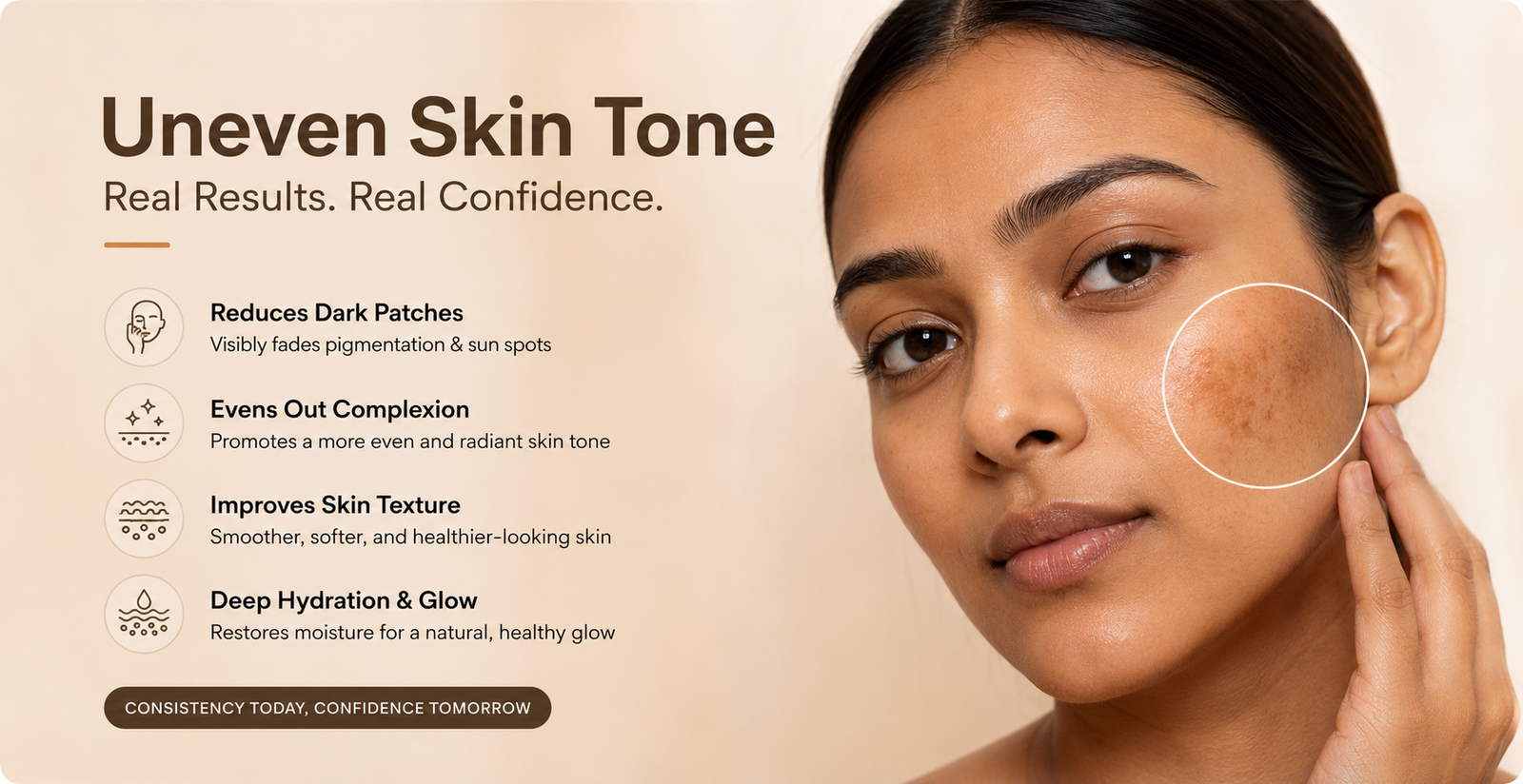
Uneven tone skin means patchy discolouration across the face: darker zones, lighter patches, or a general mismatch between different areas. It is caused by uneven melanin distribution driven by UV exposure, post-inflammatory hyperpigmentation, hormones, and chronic skin stress. Natural treatment combines a targeted multi-active serum with daily SPF and a few consistent habits. Visible improvement typically takes 6 to 8 weeks.
Individual results vary based on skin type, concern severity, and consistency of use.
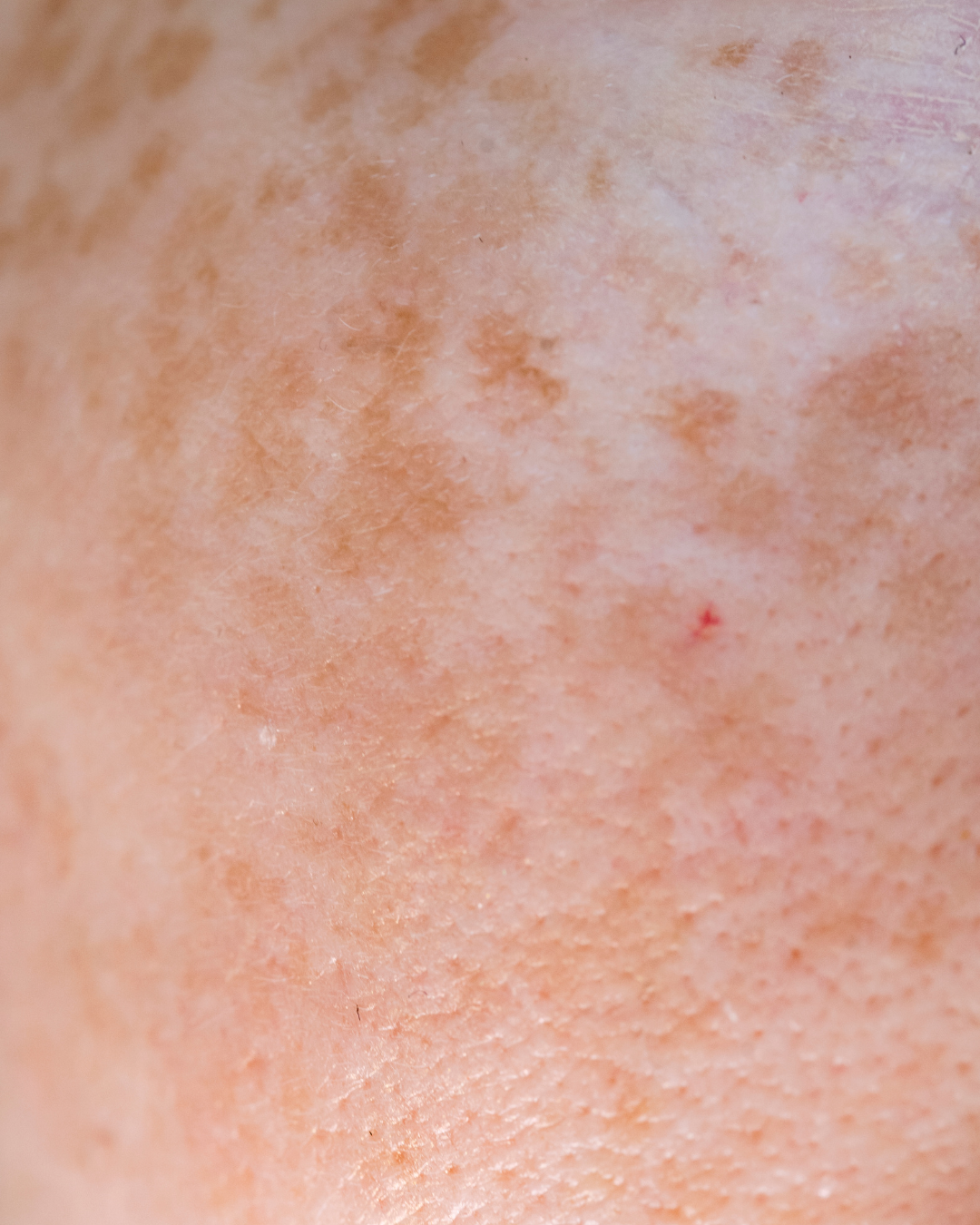
Uneven skin tone meaning is simpler than most people expect. When your skin produces melanin unevenly, more in some areas and less in others, the result is a visible patchwork of darker and lighter zones. This is uneven tone skin, and it is a symptom, not a single condition.
What is uneven skin tone at the biological level? Your melanocytes (pigment-producing cells) are behaving inconsistently, triggered differently across different facial zones by years of sun exposure, acne concentrated in certain areas, or hormonal shifts that deposit pigment symmetrically on the forehead and cheeks.
Unlike a single dark spot, uneven face skin tone is about the overall distribution of pigmentation across the face, which makes it a slightly different challenge to treat.
Most uneven tone skin does not have one cause. It is usually an accumulation of several triggers building up over time.
Sun exposure is the number one driver of uneven face skin tone. UV hits different parts of the face at different angles and intensities. Cheekbones, the nose bridge, and the forehead get more direct UV than the sides of the face. Over years, this creates zones of heavier melanin deposition that make the face look patchy.
Every breakout, cut, or inflammatory episode leaves a melanin deposit during healing. On Indian skin, where the baseline melanin response is stronger, these deposits are darker and last longer. Repeated acne over years, distributed unevenly across the face, is one of the most common causes of uneven tone skin on Indian skin.
Melasma, the symmetrical pigmentation pattern common in Indian women, is driven by estrogen and progesterone fluctuations during pregnancy, contraceptive use, and perimenopause. It concentrates on the cheeks, forehead, and upper lip, adding to overall uneven distribution when it coexists with sun-driven pigmentation elsewhere.
India's air quality introduces heavy particulate matter and oxidative stress onto the skin daily. This triggers low-grade inflammation that disrupts melanin regulation, independently of UV, which is why uneven skin tone can worsen in cities even with good sun protection.
For Indian skin, the problem compounds faster. Higher baseline melanin density means more pigment is already present, so even small repeated triggers (pillowcase friction, habitual face touching, mild seasonal inflammation) create a visible cumulative effect over months and years.
Most home remedies for uneven skin tone float around social media with very mixed results. Some help, most do not, and a few actively make things worse.
For context on how different pigmentation types respond to treatment, the Types of Skin Pigmentation Treatment guide breaks this down clearly.
Home habits support the process, they cannot do the heavy lifting. How to get rid of uneven skin tone meaningfully requires actives that interrupt melanin at the cellular level, not just mask or brighten the surface temporarily.
The Kinoko Labs Anti-Pigmentation Serum targets uneven tone skin through a multi-stage active approach built around verified ingredients:
The full spectrum of active ingredients, not a single hero, is what drives the uneven tone correction.
Based on Kinoko Labs' internal clinical testing. Individual results vary.
The science behind mushroom bioactives explains the cellular mechanism, specifically how Ganoderma Lucidum interrupts tyrosinase without the irritation risk of retinol or high-percentage AHAs.
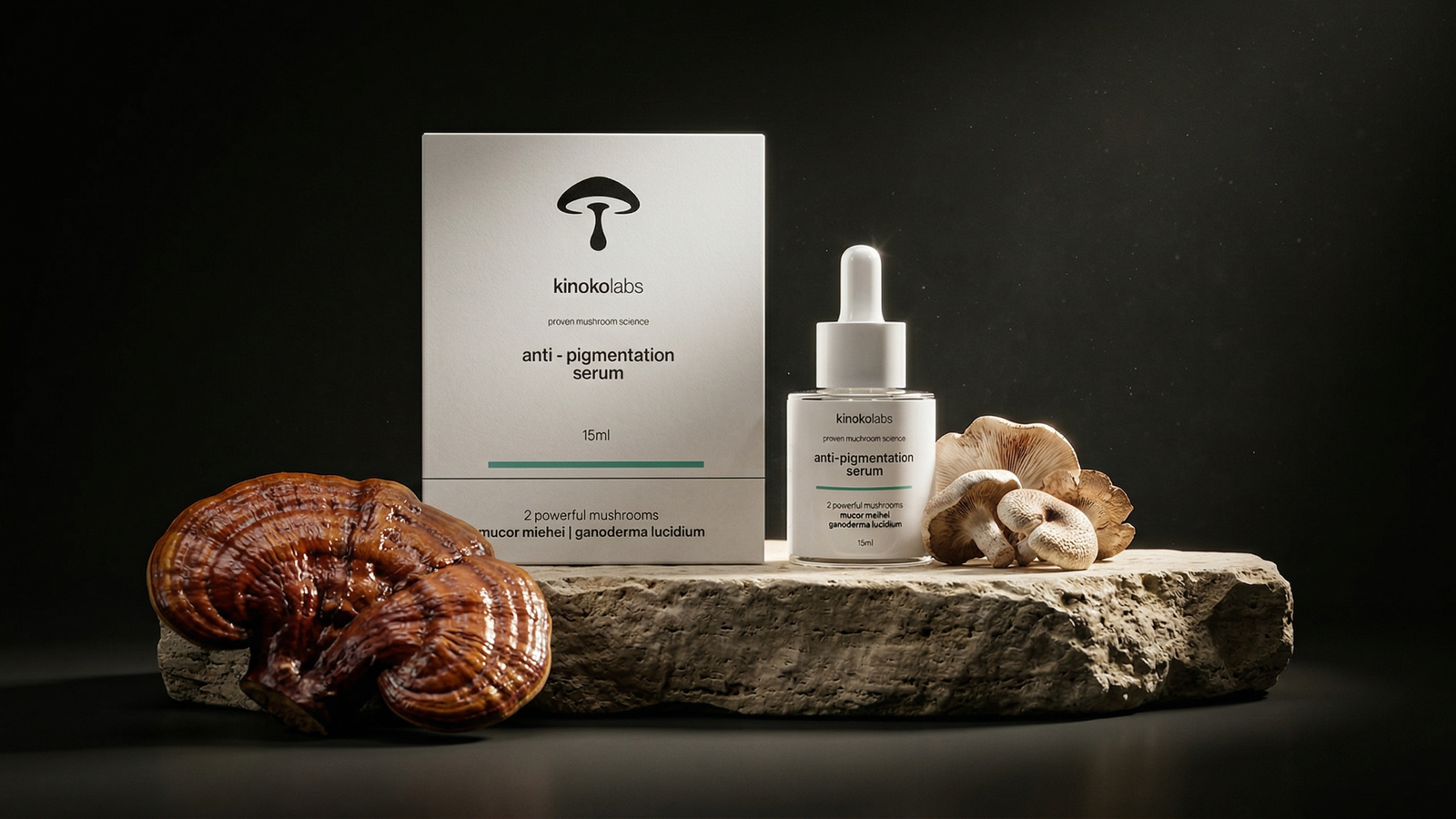
A multi-active, mushroom-powered formula calibrated for Indian skin. Gentle enough for daily use, fragrance-free, and built to interrupt melanin at three points in the cycle.
This is a reasonable question to ask before spending money. Most pigmentation serums on the Indian market fall into two categories, and both have significant limitations for uneven tone skin on Indian skin specifically.
| Feature | Typical Brightening Serum | Typical Chemical Exfoliant Serum | Kinoko Labs Anti-Pigmentation Serum |
|---|---|---|---|
| Primary mechanism | Single-active surface brightening (Vitamin C, Kojic Acid) | Surface exfoliation (AHAs, BHAs) | Multi-stage melanin regulation at cellular level |
| Points in the melanin cycle targeted | 1 | 1 | 3 (production, transfer and surface clearance) |
| Calibrated for Indian skin | Usually no, formulated for lighter skin types | Usually no | Yes, botanical complex includes Indian skin-specific actives |
| Risk of irritation on sensitive skin | Moderate to high (high-percent Vitamin C oxidises, AHAs disrupt barrier) | High | Low, gentle enzymatic exfoliation, no synthetic harsh actives |
| Treats cause or masks surface | Masks surface (temporary brightening) | Treats surface | Treats cause at cellular level |
| Approach to hyperpigmentation types | Usually targets one type | Usually targets one type | Works across PIH, sun damage and diffuse uneven tone |
| Indian botanical actives | Rare | Rare | Turmeric, Licorice, Indian Madder, Sea Buckthorn |
| Fragrance and synthetic additives | Often present | Often present | Fragrance-free |
Swipe sideways to see the full comparison on mobile.
The core difference is where the treatment happens. Most brightening serums work on the surface, removing already-visible pigmentation or masking it with temporary luminosity. How to reduce uneven skin tone permanently (or at least sustainably) requires stopping new melanin from forming, which is what tyrosinase inhibition and melanin transfer reduction achieve.
A Vitamin C serum can brighten temporarily. Add a UV trigger, a new breakout, or a hormonal shift, and you are back to square one because the melanin pathway was never interrupted upstream.
For a broader view of how other Indian serums approach hyperpigmentation, the Best Serum for Hyperpigmentation in India guide provides a comparative framework.
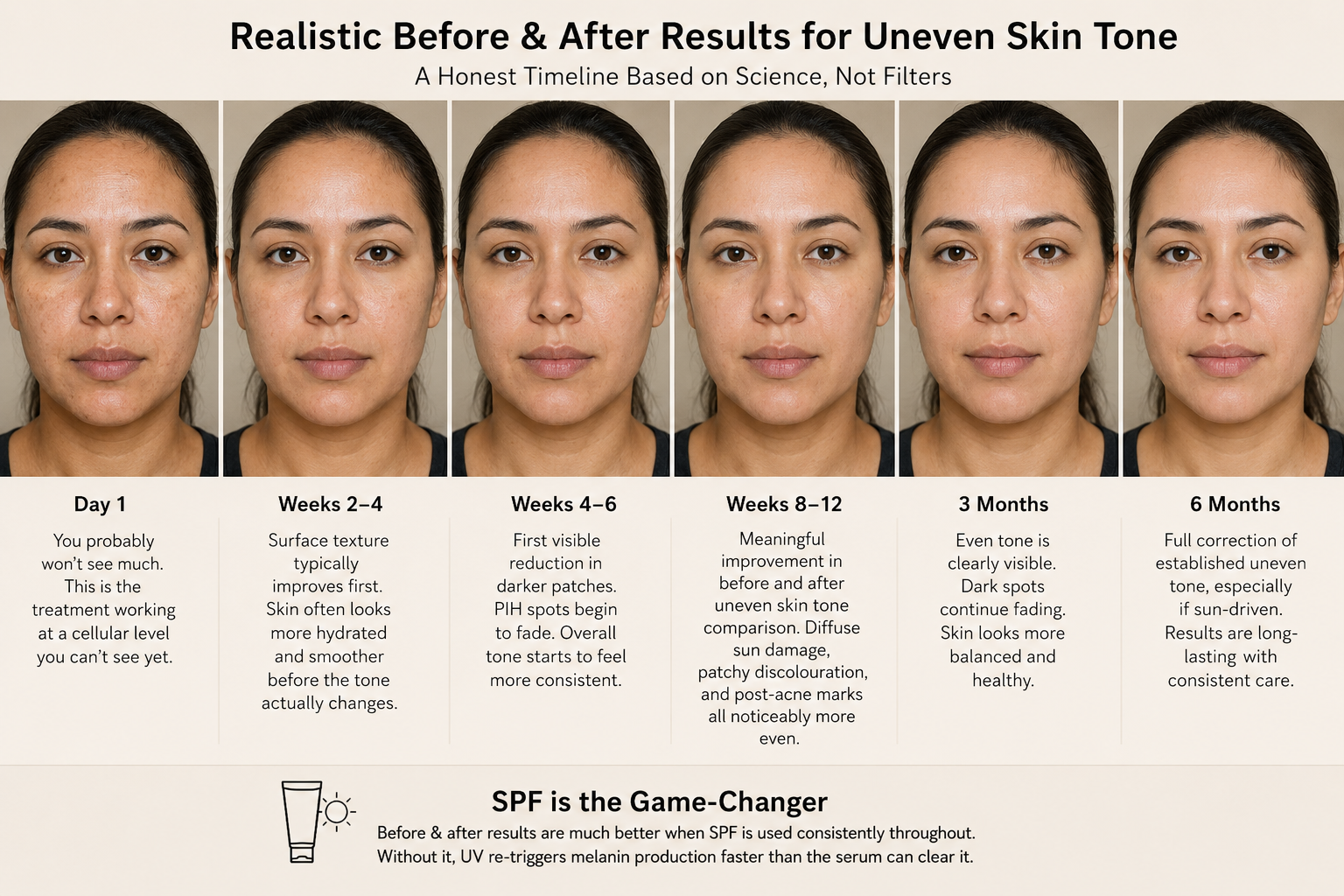
Before and after uneven skin tone treatment, what should you actually expect? The realistic honest version, not the filter version:
You probably will not see much. This is the treatment working at a cellular level you cannot see yet.
Surface texture typically improves first. Skin often looks more hydrated and smoother before the tone actually changes.
First visible reduction in darker patches. PIH spots begin to fade. Overall tone starts to feel more consistent.
Meaningful improvement in the before and after comparison. Diffuse sun damage, patchy discolouration, and post-acne marks all look noticeably more even.
Full correction of established uneven tone, especially if it is sun-driven.
Before and after results are much better when SPF is used consistently throughout. Without it, UV re-triggers melanin production faster than the serum can clear it.
Not sure which Kinoko Labs products work together for your skin? The Discovery Box includes 5ml of all five serums, a practical way to try the Anti-Pigmentation formula alongside complementary options before committing.
"Cure" is not quite the right word. Uneven tone skin responds to treatment but requires maintenance to stay clear, because the triggers (UV, inflammation, hormones) do not permanently go away. A more accurate framing is sustained correction.
How to cure uneven skin tone in practical terms means building a routine that:
People who treat pigmentation successfully once and then drop their entire routine typically see a gradual return of uneven tone within 3 to 6 months. People who maintain a lighter "maintenance" version of the routine, serum 3 to 4 times a week plus daily SPF, keep their results much longer.
Uneven tone skin means patchy melanin distribution across the face: darker zones from acne marks, sun damage, or hormones alongside lighter areas. It is a symptom of uneven melanin behaviour rather than a single condition.
It is an umbrella term for any visible pigmentation inconsistency across the face: post-acne marks, sun-driven pigmentation, melasma, and general dullness, anything disrupting an even, smooth skin colour.
Partially. Daily SPF, hydration, and an antioxidant-rich diet genuinely support correction. But they are supportive, not curative. Actual melanin regulation requires clinically active ingredients.
Two-stage melanin regulation works better than single-active brighteners for Indian skin. A serum combining tyrosinase inhibitors (Ganoderma, Pea Extract, Licorice) with melanin transfer reduction (Niacinamide) and enzymatic surface clearance (Mucor Miehei) addresses the stronger melanin response of Indian skin.
Surface texture improves in 2 to 4 weeks. Visible tone correction at 6 to 8 weeks with consistent twice-daily use and daily SPF. Full results for established pigmentation at 12 weeks or longer.
Weeks 1 to 4: improved texture and hydration. Weeks 4 to 8: visible fading of darker patches and more even tone. Weeks 8 to 12: meaningful overall improvement. Dramatic before and after transformation without clinical intervention is not realistic in under 4 weeks.
Build a routine that clears existing pigmentation (6 to 12 weeks with serum) and prevents new melanin formation (ongoing SPF plus maintenance use). People who drop their routine entirely typically see a return of uneven tone within 3 to 6 months.
Vitamin C brightens by reducing existing surface melanin, it does not stop new melanin from forming. Once you hit a UV trigger, a breakout, or a hormonal shift, unevenness returns because the melanin pathway was never interrupted upstream.
This content is for informational purposes and is not medical advice. Individual results vary based on skin type, concern severity, and consistency of use. Consult a qualified dermatologist for personal skin concerns.

